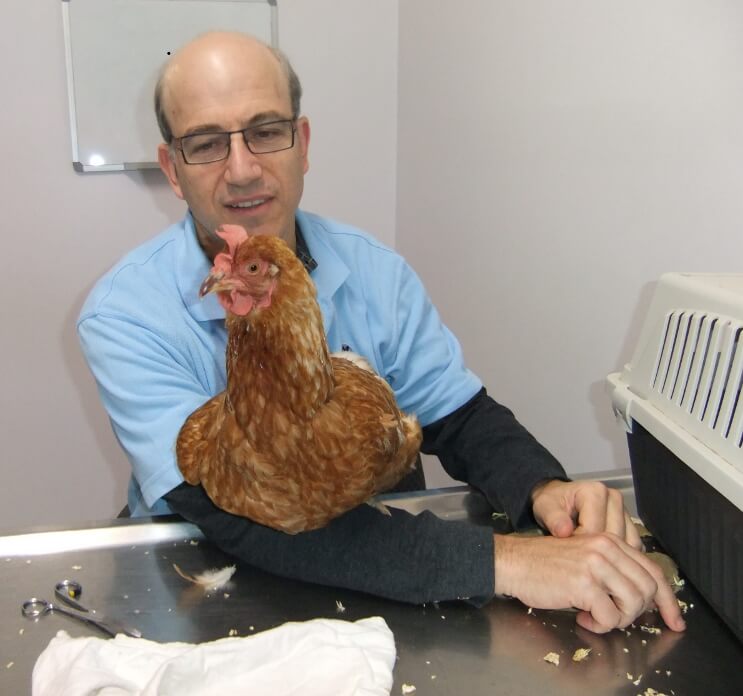
Parrot Behaviour - By Dr Phil Sacks Avian Vet
Basic bird behaviour principles from Dr Sue Friedman
For more info go to http://www.behaviorworks.org/htm/articles_behavior_change.html
- Behavior is what a parrot does, under certain conditions; behavior is not what a parrot is.
- Every behavior serves a purpose for your parrot; the purpose is the consequence the behavior produces.
- Parrots naturally choose the behaviour that yields the most positive consequences.
- Parrots naturally choose the behaviour that yields the most positive consequences.
- Every parrot is an individual and has a personal point of view about what consequences motivate him or her to behave.
- To learn what motivates your parrot, carefully observe favorite items, activities, and people.
- Increase your parrot's good behaviour by delivering positive reinforcers immediately and consistently.
- The bad news is you can unintentionally reinforce problem behaviors too to avoid problem behaviors, arrange the environment to make the right behavior easier and more effective than the wrong behavior.
- Reinforce small improvements toward the final behavior goal.
- You get what you reinforce so catch your parrot being good.
Foraging diet - parrot diet Enrichment - and parrot behaviour - with help From Dr Brian Speer
Start by simplifying the diet to a primary "fortified product", pellets with a small amount of seeds and then emphasize and teach foraging activities with favorite food items - usually seed.
A fair goal would be to ultimately have your bird "no longer with a food bowl" even offered, but multiple "problems" and devices with which to work in order to acquire maintenance base diet. (Like us going to work each day)
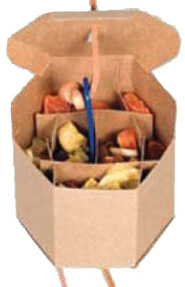
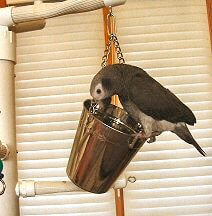
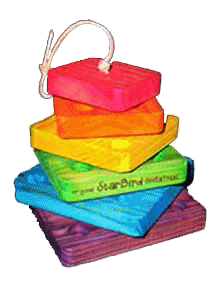
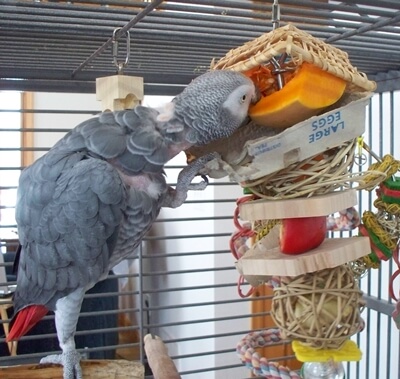
Eg : Food In an scrunched A4 piece of paper, in wooden logs (with holes drilled in). Under woodchips, in foraging toys. In multiple food dishes .(We sell parrot toys had have a range of foraging parrot toys)
These food acquisitional skills are not easily or necessarily quickly taught, but are very very important in guiding the bird to other maintenance behavioral activities that:
- Have nothing to do with sex.
- Nothing directly to do with the owner.
- Psychologically stimulating and very enjoyable for the bird.
The Hormonal parrot
For birds overbonded to owners in a sexual way: in general Dr Phil at Bird Vet Melbourne suggests to try to work to use counter conditioning. Teach other social interactive behaviors between owner and bird that have nothing to do with sex, and that provide good enjoyment and feed back to both parties. These can include simple trick training exercises, vocal training, pick-up-and-carry behaviors, hanging out , eating together..etc.
If done well, the bird begins to learn new things from owner that do not feed back to the sexual hormonal problem, Our parrot behavior service with Kate our bird behaviorist form "pets behaving badly" can provide the owner with a level and type of interactive enjoyment that he is not familiar with - leading both to want to do more, and hopefully the behavioral momentum begins to then shift towards a healthier place. - more flock related and mutually beneficial activities..
Dr Phil At Melbourne Bird Vet suggests : We must Try and Avoid the easy shortcut "traps" that are so commonly requested and used ie
a) using drugs to slow down hormone release alone, without the above and other behavior change concepts being realistically implemented,
b) Seeking a surgical "solution" without addressing those concepts above,
c) Seeking behavior-change by trying to punish sexual behaviors when seen in the bird, as a sole-strategy,
d) Using deprivation methods to alter behavior - forced dietary change, removal of bird from owner interaction, removal of bird from existing cage environment, removing favorite toys, etc.
Although these common things are done all the time with parrots especially cockatoos with reproductive drive-associated issues, in the bigger scheme of things - they often lack key ethical components, and foundational application of good behavioral science.
Hence, longer term failures become a bit more of the norm, unfortunately.