Surgery in birds - By Dr Phil Sacks Avian Vet
Surgery on my bird Doc you must be joking! - "3D" incredible surgery.
The Australian public is generally unaware of the avian surgical skills and good bird anaesthetic outcomes that avian veterinarians are routinely achieving. As an example many avian vets have successfully performed hysterectomies on birds as small as 14 grams. At Bird Vet Melbourne, we routinely do bird anaesthetics and surgery on avian patients. With safer gas anaesthetics and improved experience, avian veterinarians are able to perform more complex surgeries and the myth of birds dying routinely under anaesthesia is slowly being dispelled.
A three and a half year old Isa Brown hen named "3D" was presented to the Chook vet at Bird Vet Melbourne. She had been deteriorating progressively for two months and now had a large smooth round mass like a "soccer ball" that filled her entire abdomen. She could hardly move. Bird vet Melbourne had never seen such a large mass in a bird that size. The stomach and intestines were so compressed by the mass that 3D was unable to pass food and as a consequence she was slowly starving to death. Her keel bone or sternum was sharply protruding - as the breast muscle withered away; she was emaciated. 3D was barely able to stand and she breathed with difficulty as the mass obliterated her breathing "sacs". She had been left for so long and now euthanasia was looming. "Your bird has a large mass that is likely a tumour," Chicken Vet Dr Phil told the family." And the prognosis for recovery at this late stage is poor." Without much hesitation the owners consulted each other and said "Dr Phil can you give her chance - we love her". The prognosis was not good. Nevertheless, 3D was scheduled for surgery later that day. Dr Phil hoped that she would have enough strength to survive till her scheduled surgery as she was very weak.
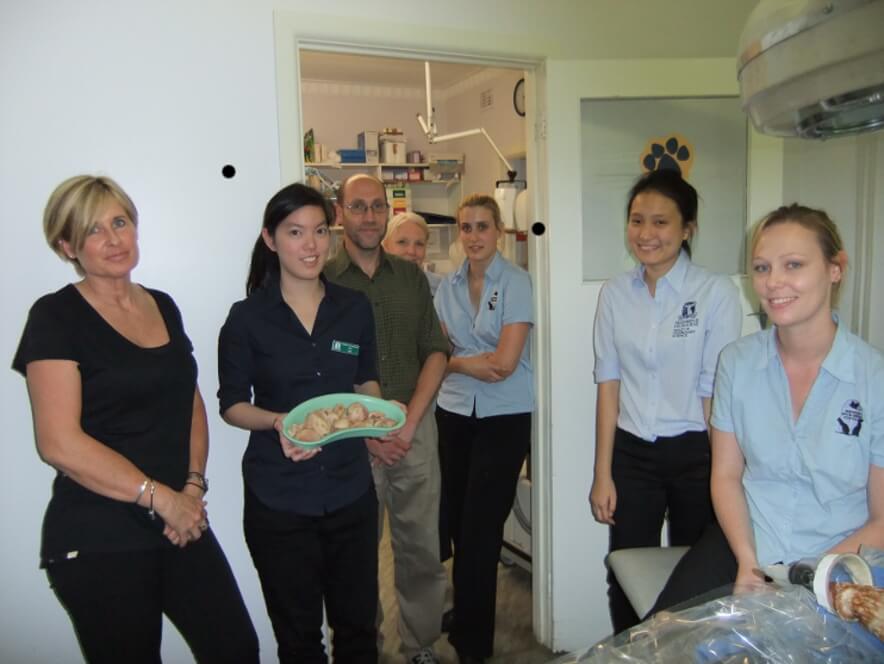
The Avian Surgical team (see Picture 1). It is convenient to have a team to optimally perform avian surgery on a chook. We are often fortunate enough to have such a team in our Melbourne based bird vet teaching hospital. The bird surgery team comprised of three veterinary nurses - three senior veterinarians - and two final year vet students. Eight people in total.
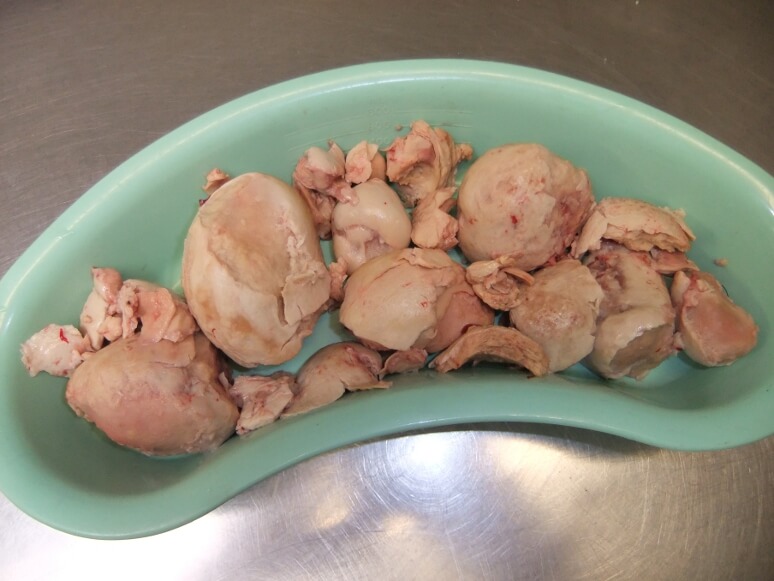
The are five key elements to successful avian surgery 1) Time: Keeping chicken surgical and anaesthetic time to the minimum, the chicken vet surgeon needs to work quickly and efficiently. All bird surgery equipment is prepared and ready beforehand, limiting the bird surgical and bird anaesthetic time 2) limiting bleeding and blood loss. The bird-vet patient must not loose much blood. We use radio surgical electro cautery units to cut and clot with virtually no bleeding during the operation. 3) maintaining blood pressure, hydration, and glucose levels. 4)maintaining body temperature : Birds have high metabolic rates, high body temperatures and a of about 40 degrees and are small so they loose heat rapidly while "under the knife". We keep the patient warm before during and after surgery. And 5) having an experienced anaesthetist and surgeon makes all the difference. We opened up 3D from left side to right side - and were struck by the extensively large mass. It was so big that it was hard to workout what was normal and what was not. It appeared to fill the whole abdomen. The mass was eventually excised and it was found to be a uterus more than 100 times enlarged, filled with yolky mass (see picture 3). The mass weighed more than 692 grams after removal which is more than one third of the hens weight. We were able to remove all of the mass, the wound was rapidly closed up, there was virtually no blood loss. We had one or two close calls with the anaesthetic, with 3D stopping to breath and bird - nurse Tash, the dedicated avian anaesthetic nurse, who is well experienced in avian anaesthesia, was able to ventilate the bird until the voluntary breathing reoccurred. Having a dedicated monitoring anaesthetist is imperative.
Miraculously, 3D finally recovered, after a long post-anaesthetic recovery with Tash ventilating her for about forty minutes post operatively. After a crop feed and drip fluids administered 1 hour and 4 hours after surgery, the patient recuperated well. Post operatively, to stop further ovulation, a hormone implant was placed. This long acting, slow-release hormone will stop ovulation and egg production and will give 3D a well deserved break from laying. We are routinely implanting good pet layers with the hormones to switch off laying and give the female chooks a break. Chicken vet Melbourne - Chook vet
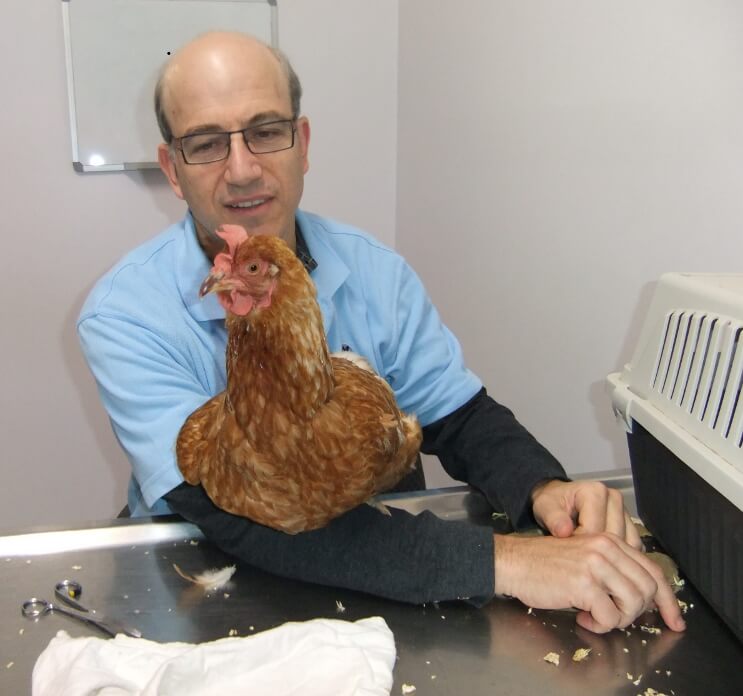
3D came back 10 days after surgery for a check up and I removed her protective bandage. As I sat discussing the case with the owners, 3D walked up to me, gently climbed onto my arm and made her self comfortable, sitting on me. It felt like a "thank you". (See Picture 3). 3D is now back at home with her flock and loving family, has regained weight and has reaffirmed her place in the pecking order. One lucky bird.
Picture 1 The chicken vet - surgical team - assisting Dr Phil
Picture 2 The 700 grams of egg yolk material removed
Picture 3D Warming up to Dr Phil see left hand corner