


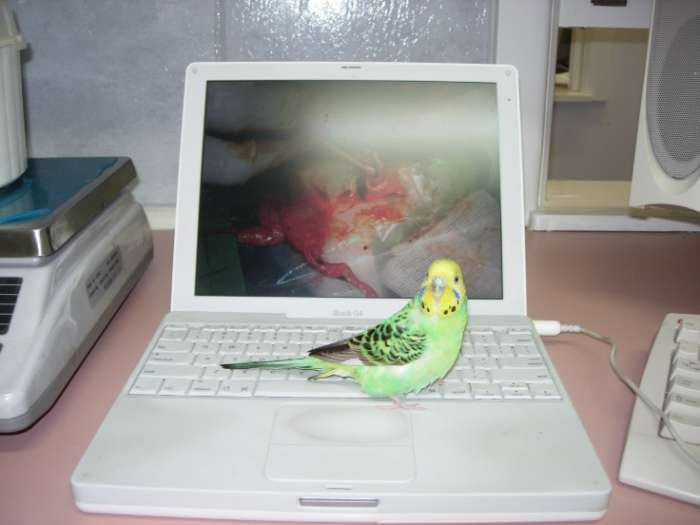
The budgerigar, Melopsittacus undulatus, has been one of the world's most popular pets. They are a common species seen at our Melbourne budgie vet clinic. Their playful nature, twittering antics and speaking ability have brought joy to millions of people. With correct care, budgies provide years of companionship: average life expectancy is about nine years but well looked after pets may reach their mid teens. Average weight is from 35 to 55 g, quite little for such big personalities! Budgies evolved in Australia's dry interior.
Housing and Husbandry for Your Pet Budgerigar - Budgie Vet Advice
Budgies can be kept in a large cage or aviary. Remember that budgies fly horizontally like airplanes rather than vertically like helicopters. It is more important for their cages to be long and wide rather than tall. DO NOT HANG THE SWING IN THE MIDDLE TOP OF THE CAGE! OBSTRUCTING FLIGHT AND MOVEMENT.
- Perches should be natural wood of varied diameters starting at 1.5 cm. Place at opposite ends of the cage to encourage flight. No sandpaper on perches.
- Place multiple feed dishes - three - at the bottom of the cage to encourage "exploring".
- Interactive toys (see our great selection and most are less than $10) and Native Australian tree branches, gum nuts, grasses & greenery should be put into the cage for behavioural enrichment & beak care.
- Remember that birds fly horizontally like airplanes rather than vertically like helicopters. It is more important for their cages to be long and wide rather than tall. Place toys on the sides of the cage and do not clutter their flying area.
- Rectangular cages are preferred.
- Cover the birds at night and have a safe covered corner for the birds to relax in the day. See our fantastic granny sewed "day corner cage buddies"
Do not line the floor of the cage with grit.
Budgie Diet - Budgie Vet Dr Phil Recommends Feeding Each of the Four Food Groups Every SINGLE Day
- Dark green vegetables - whichever your bird prefers EG: spinach, silver beet, grated carrots, beans, peas, broccoli
- Limited seed eg 2 teaspoons/day of small seeds - Decrease the seed gradually over 8 weeks as you introduce new foods.
- Low fat low sugar human foods like oats, multi-grain bread, pasta, wheat-bix etc is also good - It is so bonding to share a meal together especially for the single pet bird.
- Pellets like Harrison's, Pretty Bird or Vetafarm - offered mixed with the seed in all three food containers
Share appropriate human food with your pet - so good for them psychologically!
Fruit especially apples, also pasta, rice, occasional hard-boiled egg. Sprouted seed is excellent nutrition. If your bird eats the four food groups every day, supplements are usually not necessary.
PROJECT Budgerigar Vet Dr Phil Likes: take some seed and let it grow in a pot plant - and offer the grasses to your bird.
* Avoid chocolate, caffeine, alcohol or avocado as these may be toxic.
Common Budgie Illnesses Seen at Our Melbourne Budgie Vet Clinic
- Trichomoniasis ('canker') associated with vomiting and deaths in young birds - All new birds should be tested for this. The most common cause of death in new birds.
- Megabacteria, a chronic fungal debilitating disease caused by the fungus Macrorhabdus ornithogaster.
- Chlamydiosis, a disease that humans can catch from birds caused by Chlamydophila psittaci.
- Scaly Face Mite caused by Knemidokoptes mites that burrow under the skin.
- Tumors are relatively common in older budgies especially associated with the reproductive tract and kidney - often causing lameness in one leg.
- Note: Mites, lice, Yeasts and worms rarely cause problems in pet Budgies.
Budgerigar Health Care - Melbourne Budgie Vet - Dr Phil Sacks
Budgies often hide signs of illness and may only appear unwell when they are very sick. It is important to take a sick bird to your budgerigar vet early rather than later.
By bringing your bird in early it often saves costs by reducing the need for intensive care and hospitalization in a very sick bird as well as improving the chances of a good outcome.
We recommend a health check with a budgie vet when you acquire your new budgie, to discuss care, training and diet and to check for common illnesses listed above.
Because budgies are desert birds they may go for many days without drinking, hence drinking water medication is not a reliable way to administer drugs in a sick bird.
The Budgerigar: an Important Family Member and Veterinary Patient
Dr Phil Sacks - Burwood Bird and Animal Hospital. From Talking Birds newspaper Dec 08
Budgies are the original "pet" parrot. With the correct care, husbandry and stewardship, these little parrots can provide years of companionship and joy. This article will review common medical diseases and husbandry problems seen in our avian budgerigar caseload in Burwood, Melbourne Victoria.
The budgie (Melopsittacus undulatus), is the most common patient in our Melbourne Avian Veterinary Hospital. It has many unique characteristics and traits that make it a more suitable pet than larger parrots. They are able to entertain themselves with rudimentary toys and can be a delight to watch. Their beautiful twittering by both males and females can brighten up a home and often a life. Budgerigars as pets often result in very strong human animal bonds. They weigh an average of just under 40g - surprisingly light for such big personalities.
Many behavior problems found in larger parrots are rare in these birds. In our clinic the longevity of Budgerigars on average is under 10 years of age. Tumors, trauma, disease, husbandry and malnutrition greatly shorten the average lifespan. We significantly increase the longevity of birds in our care - often seeing birds reaching 12 years plus. I have listed three common syndromes or conditions as they relate to this genus.
1) Trichomoniasis or Canker - Common Budgie Disease
This disease is number one because many pets and aviary birds, sometimes entire collections die needlessly from trichomoniasis. It is an easy disease to diagnose and treat. Had birds come in for a health check on purchase this could readily be managed. This is the most common cause of a pet bird "just dying" in the first 2 years of life and a common cause of sporadic deaths in aviaries. So many pet owners wish they had heard about this disease, as they lose bonded much loved pets after such a large expenditure of love and time and energy.
The disease is caused by a protozoal organism trichomonas. It is similar to the organism causing canker in pigeons and birds of prey (that eat pigeons) and a relatively common STD infection in humans. Cross infection between the budgerigar and other species is not thought to occur. Amazingly this budgerigar syndrome is unique to Australia, occurring only rarely in other countries. Hence there is limited internet information available on a Google search. Disease involves the crop primarily and other parts of the gastrointestinal tract. Vomiting, crop distension and respiratory disease are the most common presenting signs.
Diagnosis is by microscopic examination of crop fluid revealing the motile organism. Infection is by direct oral contact between birds and also via the shared drinking water. Treatments include nitro imidazole drugs like carnidazole, ronidazole and metronidazole. Treatments are relatively cheap and easy to administer with a good prognosis in subclinical infections. Prevention - All newly purchased pet and aviary budgies should be tested and in certain cases prophylactic treatment is indicated for this disease.
2) Cage Layout - Perch Size - Cage Furniture for Budgies
Budgies are more like airplanes than helicopters in the way they utilize their upper air space - they fly horizontally. They also cherish environmental enrichment. The cage furniture needs to be arranged accordingly. It can make a huge difference in your budgie's quality of life. Birds need to be able to fly between perches placed at opposite ends of the cage, utilizing the full length of the cages. Unfortunately many cages are purchased with a swing hanging in the middle of the cage, making flying impossible and breaking up the airspace.
The bird's cage is often their home. Cage layout is extremely important, it should be done with care and thought. Arrange the cage furniture accordingly. The perches, toys, food, etc. should flow so that the bird can utilize the complete space in the cage. We recommend a variety of perches of different diameters and materials. We also recommend a variety of safe toys placed on the cage sides. A play gym for birds that are out of the cage is great.
Sleeping - Budgies will usually sleep on the highest perch as they instinctively feel safer there. They lift one leg and place their sternum on the perch for support and comfort. Birds need a large diameter natural branch perch to sleep on: about 3 cm diameter is ideal. Make sure this "comfortable mattress" perch is highest.
3) Malnutrition and the All-Seed Diet - Budgie Vet Advice
Nutritional disease is very common. The nutritional requirements of "grain eating" parrots are similar regardless of size. But for some reason smaller parrot nutrition has lagged behind that of the larger parrots like greys and amazons. The usual complete "budgerigar seed mix" is based on folklore and tradition, is unbalanced, unhealthy and not complete. An ideal diet consists of a variety of foods provided on a daily basis, including daily dark green vegetables, a good quality pelleted diet, and a small amount of seed. Sprouted seeds are a great addition. Low fat low sugar human foods can also be offered in small amounts.
A bird offered unlimited seed will often ignore the healthy foods. They are not able to self select when offered a choice of foods. Common nutritional problems we encounter include: Overgrown nails and beaks from a long term fatty diet causing fatty liver disease that affects epithelialization. The beak grows rapidly and abnormally and requires regular trimming. Tumor like masses form related to the high fat content:
- Lipomas are the most common fatty tissue masses. They result from excess fat deposition and are usually found below the chest.
- Xanthomas are more aggressive and often result in bleeding necessitating surgery and amputations. These masses are caused by excess fat intake.
Other less obvious syndromes include metabolic collapse with organ failure, heart disease, abnormal digestion and diabetic syndromes. Many complications of pet budgerigar egg-laying can be prevented by proper diet.
Book a Budgie Vet Consultation Today
Our Melbourne budgie vet specialists are here to help with all aspects of budgerigar care, from routine health checks to treatment of common diseases. Early intervention is key to keeping your budgie healthy and happy for many years.